
Last Updated: November 24, 2026
PLAR in Ontario: How Newcomer Students Get High School Credit for Schooling Done Overseas

TL;DR:
- PLAR is how an Ontario high school credits learning done somewhere else. It stands for prior learning assessment and recognition, and the school principal runs it and grants the credits.
- A teenager arriving from overseas usually goes through equivalency. The principal reads the old school record and grants a block of Ontario credits, for placement. The transcript shows the total, with "EQV" where a mark would be.
- The years completed abroad set the starting point. The ministry's guide says a student with one year of secondary school done still needs 22 Ontario credits, two years 14, three years 7, and more than three years 4.
- Challenge is a second, separate route. A student can earn up to four credits, no more than two in one subject, by passing a Grade 10, 11 or 12 course's assessments without taking the course.
- A student at least 18 on or after 1 January of the school year follows a different memo, PPM 132. It allows up to 16 Grade 9 and 10 credits and up to 10 Grade 11 and 12 credits.
- Publicly funded boards charge no fee for either process for resident pupils, and a parent who disagrees with the placement decision for a student from outside Ontario, or with a decision on whether to allow a challenge, can ask the appropriate supervisory officer to review it.
Minimum OSSD credits still to earn under the Ontario Ministry of Education placement guide table (checked November 24, 2026).
What PLAR means in an Ontario high school
Search "PLAR Ontario" and Google mixes two different things. On 24 November 2026 the first page held a college application PDF from Newfoundland, a digital badge, a 2021 video, college pages and a blank equivalency form. Google's AI summary listed school board pages next to the college guide, then ended by asking whether the reader meant high school or college.
They are separate systems. High school PLAR gives credit toward the Ontario Secondary School Diploma (OSSD), and it runs under the ministry's own rules for secondary schools. The college pages in the results are not about the diploma, and this article does not cover them.
The ministry's policy, Ontario Schools, Kindergarten to Grade 12: Policy and Program Requirements, defines it this way: "The prior learning assessment and recognition (PLAR) process evaluates skills and knowledge against the overall expectations of the Ontario Curriculum." It adds two plain rules. PLAR is "carried out under the direction of the school principal, who grants the credits", and "The implementation of PLAR is mandatory."
What follows is checked against that policy, the two ministry memos that govern PLAR (PPM 129 and PPM 132), the Ontario Student Transcript manual, the Waterloo Catholic District School Board's procedure and the web pages of two other boards (Hamilton-Wentworth and Niagara), all read on 24 November 2026.
Which PLAR route applies to your child
PLAR has two parts, equivalency and challenge, and a separate memo covers mature students. The ministry defines the two parts in one line each: "Challenge is the process of assessing students' prior learning for the purpose of granting credit from the Ontario Curriculum. Equivalency involves assessing credentials from other jurisdictions."
| Equivalency (PPM 129) | Challenge (PPM 129) | Mature student (PPM 132) | |
|---|---|---|---|
| Who it is for | A student transferring from a school outside Ontario, a non-inspected private school or home schooling | A day school student who already knows a Grade 10, 11 or 12 course | A student at least 18 on or after 1 January of the school year, enrolled for the OSSD |
| What it credits | A total number of credits, for placement | One named course at a time | Grade 9 and 10 credits by assessment; Grade 11 and 12 credits by equivalency or challenge |
| Limit | Set by the principal; the ministry guide gives the credits still to earn | Up to 4 credits, no more than 2 in one discipline | Up to 16 Grade 9 and 10 credits, and up to 10 of the 14 Grade 11 and 12 credits |
| How it is assessed | The principal's evaluation of the student's previous learning | Formal tests worth 70% of the mark, other assessments worth 30% | Individual assessments for Grades 9 and 10; documents or challenge for Grades 11 and 12 |
| On the transcript | One line: the credit total, with "EQV" in the mark column | A percentage mark for a pass; a failed Grade 10 challenge is not recorded, while Grade 11 and 12 passes and fails are | Not covered here; ask the school how it records them |
| Who decides | The principal | The principal, and only Ontario certified teachers run the assessments | The principal |
For a teenager arriving with a school record, equivalency is the usual starting point. Challenge is for a course the student already knows.
Equivalency: turning an overseas transcript into Ontario credits
When a secondary student transfers from a school outside Ontario, the policy says "the principal of the receiving school will determine the total credit equivalency of the student's previous learning along with the number of compulsory and optional credits still to be earned." PPM 129, the memo for students in regular day school, is blunter: "Equivalency credits are granted for placement only."
Those two statements fit together once you see the transcript. The Ontario Student Transcript (OST) manual tells schools to enter equivalency as one line. The course title reads "Equivalent Credits", the course code "PLE", the percentage grade column "EQV", and the credit column carries the total. So the credits count toward the diploma's 30, but no Ontario mark comes with them. A strong Grade 10 science mark from home does not carry over as a mark on the Ontario transcript.
Ontario marks come from the Ontario courses the student takes after arrival, or from a challenge. Our OUAC application guide covers how Ontario university applications work.
Equivalency also does not set the timetable by itself. The principal decides which compulsory credits are still owed, and those set the courses the student has to take.
How many Ontario credits are still to earn
The ministry gives principals a guide table for students arriving from outside Ontario. It sets the minimum credits still to be earned toward the OSSD, by how many years of secondary school the student finished before arriving.
| Secondary school finished before arriving | Total credits still to earn | Compulsory credits still to earn | Financial literacy requirement | Literacy requirement | Community involvement (40 hours) |
|---|---|---|---|---|---|
| 1 year (for example Grade 9) | 22 | English/French 3, mathematics 2, science 1 | Required | Required | Required |
| 2 years (Grade 10) | 14 | English/French 2, mathematics 1 | Not required | Required | At the principal's discretion |
| 3 years (Grade 11) | 7 | English/French 1 | Not required | Required | At the principal's discretion |
| More than 3 years | 4 | English/French 1 | Not required | Required | At the principal's discretion |
Three rules sit around the table.
- Grade 12 English is the compulsory credit the table's footnote singles out. It says "The compulsory English credit for Grade 12 is required if its equivalent has not already been earned."
- A student with more than three years done and no Ontario credits takes senior courses. The policy says such a student "must earn a minimum of four credits in Grade 11 or Grade 12 courses to be eligible for the OSSD."
- The table is a guide, not the answer. It lists only English, mathematics and science. Students who started Grade 9 in 2024-25 or later need 17 compulsory credits, and the table does not list the others. The principal's own list of compulsory credits still owed is the one to plan from.
Read the other way, a student who arrives after Grade 10 can be credited with at most 16 of the 30 credits, and a student who arrives after Grade 11 with at most 23. Those two figures are our arithmetic from the table; the ministry does not state them.
What still applies after equivalency
Equivalency covers credits. Four other diploma requirements are handled separately.
The literacy requirement. The policy says the student "will have to meet the literacy graduation requirement". In every row of the table it stays Required. The usual route is the Ontario Secondary School Literacy Test (OSSLT), which students "usually take" in the year after Grade 9, unless the principal grants a deferral. English language learners can be entitled to special provisions. Our OSSLT explainer covers how the test works.
Community involvement hours. The principal "will also determine the number of hours of community involvement activities the student will have to complete." After one year of secondary school abroad, the guide table keeps the full 40 hours. After two or more, the number is the principal's call.
Online learning credits. The diploma requires at least two credits earned online, and PPM 167 sets an opt-out process. For a transferring student, the principal decides how many of those count as done, based on the previous learning. If the student had been exempted from the online requirement before, the policy says "a new opt-out form will need to be completed."
Financial literacy. This requirement applies to students who entered Grade 9 in 2025-26 or later. A student who enrols "in Grades 11 or 12 from outside Ontario" does not need it, if the principal grants Grade 9 and 10 credits through equivalency. The guide table marks it Required only for a student arriving after one year of secondary school.
Non-credit OSSD graduation requirements governed separately from equivalency placement (Ontario Schools policy, checked November 24, 2026).
English level and grade placement
Many parents expect a weak English score to push their teenager down a grade. The policy says otherwise: "A student's level of proficiency in English will not influence the choice of grade placement." In secondary school, "placement in a grade or specific subject will depend upon a student's prior education, background in specific subject areas and aspirations."
English still matters for the diploma. A student entering at any grade can count at most three English as a Second Language (ESL) or English Literacy Development (ELD) credits toward the four compulsory English credits. The fourth must be Grade 12 English. A board may also assess English on arrival. The Hamilton-Wentworth District School Board, for example, runs an ESL assessment at its Welcome Centre that sends the school a report recommending "program adaptations, instructional interventions and strategies."
The challenge route: credit for a course your child already knows
Challenge is for a student who could pass an Ontario course without sitting in it. PPM 129 allows it only "for Grade 10, 11, and 12 courses in provincial curriculum policy documents." The limits are firm: "Students may earn no more than four credits through the challenge process, including a maximum of two credits in any one discipline."
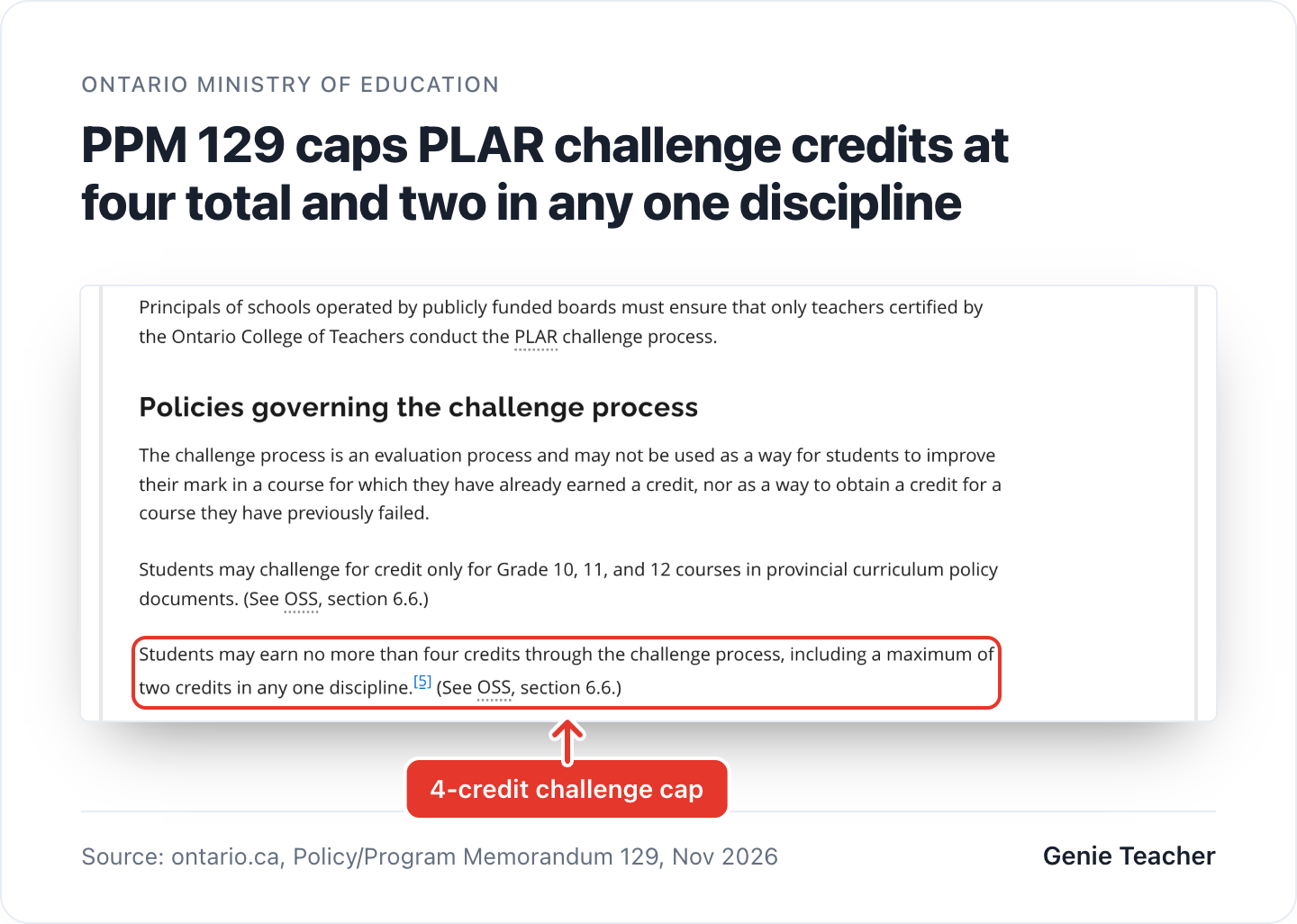
Four rules shape it.
1. The student has to show they are likely to pass. They need to give "reasonable evidence to the principal that they would be likely to be successful in the challenge process". 2. The assessment is mostly tests. Formal tests make up 70% of the final mark, and other assessments for the course make up 30%. Only teachers certified by the Ontario College of Teachers can run it. 3. A passing mark goes on the transcript. PPM 129 says achievement "will be recorded as a percentage grade on the OST in the same way as achievement in other courses." For a Grade 10 challenge only a passing grade is entered on the transcript, and nothing is entered on the transcript for a failed or withdrawn attempt. For Grade 11 and 12 challenges, the transcript manual lists courses "successfully or unsuccessfully challenged", so a failed senior challenge shows too. 4. Some courses are excluded. A student cannot challenge a transfer course, a locally developed course or a co-op course. A student who already has an Ontario English credit cannot challenge ESL or ELD.
Boards add their own rules on top. The Waterloo Catholic District School Board's procedure says "PLAR is not an instructional process. No teacher assistance is provided." It also requires parental approval for students under 18, and runs challenges to a calendar, with formal tests in January for the fall cycle and June for the spring cycle.
Core limits and grading weights for the secondary school PLAR challenge route under Ontario Ministry of Education PPM 129.
The mature-student route under PPM 132
A newcomer who counts as a mature student follows PPM 132, issued in 2023. It covers "a student who is at least 18 years of age on or after January 1 of the current school year and who is enrolled in a program for the purpose of obtaining an Ontario Secondary School Diploma (OSSD)."
The rules differ from the PPM 129 route:
- Grades 9 and 10. An individual assessment "consisting of four subject based assessments, as needed", and "up to 16 Grade 9 and 10 credits may be granted". There is no challenge process for these grades.
- Grades 11 and 12. "up to 10 of 14 Grade 11 and 12 credits may be granted through either the equivalency or challenge process", and at least four senior credits must be earned by taking the courses.
- Documents. PPM 132 accepts "formal transcripts granted by an accredited educational or training institution or a government ministry or body", along with other records of learning.
- Language. Mature students must "meet the requisite Canadian Language Benchmark" in the language of study to take part.
Board age rules can read differently. The District School Board of Niagara's adult PLAR page asks students to "Be 18 years old by August 31 of current year". Ask your board which date it uses.
Credit ceilings and minimum senior coursework for mature students (age 18+) under Ontario Ministry of Education PPM 132.
Who decides, and how to ask for a review
The principal decides, after talking it through. The policy says "Final decisions regarding placement are made by the principal in consultation with the student, staff and family." The principal then explains the decision and the reasons to the family, and should note the results and the reasons in the student's Ontario Student Record.
A parent who disagrees has a route in two cases. Under PPM 129, when a parent "disagrees with the principal's placement decision" for a student arriving from a non-inspected private school or a school outside Ontario, "the adult student or the parent may ask the appropriate supervisory officer to review the matter." The same review is open for the principal's decision about whether a student may challenge a course, and PPM 132 gives a mature student the same review of a challenge decision.
PPM 129 says "publicly funded boards will not charge students fees for undergoing the challenge or equivalency process." It ties that to the Education Act, under which a person "qualified to be a resident pupil" of a board attends school "without payment of a fee". A family on a study permit should ask the board whether the fee applies, because the Hamilton-Wentworth District School Board lists international fee-paying students on a study permit as a separate admissions category.
What to bring, and what to ask the school
The ministry sources we read give no list of documents for secondary equivalency under PPM 129, and neither do the board pages. (PPM 132 does list accepted documents, but only for mature students.) The principal evaluates "previous learning", and each secondary school's program and course calendar must describe the PLAR processes for equivalency and challenge. This is our own suggested list, not an official one. A family arriving with a teenager can bring what lets a principal read that learning:
- Official transcripts or mark sheets for every completed year of secondary school
- Course descriptions or syllabi for science, mathematics and English, where the school issued them
- Any leaving or board exam certificates
- Translations of anything not in English or French
- Proof of the student's date of birth, which settles whether the PPM 129 route or the mature-student route applies
A family without documents is not left alone with the problem. PPM 129 says the principal will ensure that students "who do not have suitable documentation owing to extraordinary circumstances (e.g., students who are refugees) will receive counselling concerning the gathering of evidence."
Then ask the school five questions. Getting the answers in writing is our advice; the policy asks only that the principal explain the decision and its reasons to the family.
1. How many equivalency credits is my child granted in total, and how many of them count as compulsory credits? 2. Which compulsory courses are still owed, by name? 3. How many community involvement hours and online credits still apply? 4. Is a challenge possible for any Grade 10, 11 or 12 course, and what are this board's challenge dates? 5. Who is the supervisory officer if we want the decision reviewed?
Our checklist for moving to Canada with school-age children covers registration and the first weeks. For students earning Ontario credits from outside the country, see our guide to OSSD credits for international students. For how CBSE, IB and UK records read in Canada, see CBSE, IB or UK to Canadian school.
Common mistakes with PLAR
Treating equivalency as a mark conversion. It grants credits, not marks. The Ontario marks come from the Ontario courses that follow.
Using a college PLAR page for a high school student. A college page does not describe the diploma; the ministry's secondary school policy and memos do.
Leaving challenge too late. A board can run challenges to its own calendar, as Waterloo Catholic does, so ask for the dates early.
What a certified teacher can do after placement
The school sets the credit total. The next question is the path: which compulsory courses come first and which courses a target program needs. A certified Ontario teacher can chart which courses the student needs to reach that program, then focus the teaching on the subject areas that get the student there.
In an Ontario high school, the principal decides what learning done elsewhere is worth. A newcomer who is not a mature student usually gets a block of equivalency credits for placement, with "EQV" in place of a mark, and a student at least 18 on or after 1 January of the school year follows PPM 132 instead. The credits do not end the requirements: the literacy requirement still applies, and so does Grade 12 English unless an equivalent is already earned. Get the credit total and the named courses still owed from the school, ask for them in writing, and ask the appropriate supervisory officer for a review if a placement decision for a student from outside Ontario, or a decision on whether to allow a challenge, looks wrong.
Once the school sets the credit total, the next question is which courses come next and which subject has a gap. A certified Ontario teacher can chart which courses a target program needs and focus the teaching on the subject areas that get the student there.
Related reading: Why a certified teacher closes the gap a "good at math" tutor can't →
- Government of Ontario, Ontario Schools, Kindergarten to Grade 12: Policy and Program Requirements, section 4: student records (updated 13 August 2026)
- Government of Ontario, Ontario Schools, section 7: secondary school courses and related procedures (updated 12 May 2026)
- Government of Ontario, Ontario Schools, section 6: diploma and certificate requirements (updated 14 October 2026)
- Government of Ontario, Ontario Schools, section 3: meeting the needs of all students (updated 13 January 2026)
- Government of Ontario, Ontario Schools, section 5: school and board information (updated 13 January 2026)
- Ontario Ministry of Education, Policy/Program Memorandum 129: Prior Learning Assessment and Recognition
- Ontario Ministry of Education, Policy/Program Memorandum 132: PLAR for mature students
- Ontario Ministry of Education, Ontario Student Transcript Manual (2013)
- Waterloo Catholic District School Board, Administrative Procedure APC029: Prior Learning Assessment and Recognition (revised May 2025)
- Hamilton-Wentworth District School Board, Welcome Centre
- District School Board of Niagara, PLAR for adult students
Free discovery session
Meet the teacher first. Pay only if it clicks.
No card needed
- 01Pick a teacherFilter by subject and grade. Look for the green “Free discovery session” badge.
- 02Meet for 30 minutesShare your child’s goals. See how the teacher explains a problem.
- 03Book only if it fitsBook lessons with that teacher, or meet another one for free.
FAQ
What does PLAR stand for in Ontario high schools?
What does PLAR stand for in Ontario high schools?
PLAR stands for prior learning assessment and recognition. In an Ontario high school it is the process the principal uses to grant credits toward the Ontario Secondary School Diploma for learning done elsewhere. It has two parts: equivalency, which assesses credentials from other jurisdictions, and challenge, which tests prior learning against a Grade 10, 11 or 12 course. A student who is at least 18 on or after 1 January of the school year follows a separate memo, PPM 132.
Do equivalency credits come with marks on the Ontario transcript?
Do equivalency credits come with marks on the Ontario transcript?
No. The Ontario Student Transcript manual tells schools to enter equivalency as one line, with "EQV" in the percentage grade column and the total number of credits in the credit column. The credits count toward the 30 the diploma needs, but no Ontario mark comes with them. A challenge is different: a pass is recorded as a percentage grade, but a failed Grade 10 challenge is not entered on the transcript, while Grade 11 and 12 challenge results, pass or fail, are.
How many challenge credits can a student earn?
How many challenge credits can a student earn?
Under PPM 129, a student may earn no more than four credits through the challenge process, with a maximum of two credits in any one discipline. Challenge applies only to Grade 10, 11 and 12 courses, formal tests make up 70% of the final mark, and only teachers certified by the Ontario College of Teachers run the assessments.
Can a student get more than 30 credits in an Ontario high school?
Can a student get more than 30 credits in an Ontario high school?
Yes. The Ontario Secondary School Diploma needs a minimum of 30 credits, and the ministry's policy notes that students may choose to take more than 30. For a newcomer the figure to plan around first is the minimum still to earn in Ontario: the ministry's guide table sets it at 22, 14, 7 or 4 credits after one, two, three or more than three years of secondary school abroad.
Is there a fee for PLAR at a public school board?
Is there a fee for PLAR at a public school board?
For resident pupils, no. PPM 129 says publicly funded boards will not charge students fees for undergoing the challenge or equivalency process, and ties that to the Education Act, under which a person qualified to be a resident pupil of a board attends school without payment of a fee. A family on a study permit, or in another category a board treats as fee-paying, should ask the board before applying.
Does my child need to pass an English test before getting credit?
Does my child need to pass an English test before getting credit?
Not for grade placement. The ministry's policy says a student's level of proficiency in English will not influence the choice of grade placement, and secondary placement depends on prior education, subject background and aspirations. English still counts toward the diploma: at most three ESL or ELD credits count toward the four compulsory English credits, the fourth must be Grade 12 English, and the literacy requirement still applies. Mature students in PPM 132 PLAR must meet the required Canadian Language Benchmark.
What if we disagree with the principal's credit decision?
What if we disagree with the principal's credit decision?
Under PPM 129, when a parent disagrees with the principal's placement decision for a student transferring from a non-inspected private school or a school outside Ontario, the parent, or the student if an adult, may ask the appropriate supervisory officer to review the matter. The same review is open for a decision about whether a student may challenge a course, and PPM 132 gives mature students the same review of a challenge decision.
Is the first session with a Genie teacher really free?
Is the first session with a Genie teacher really free?
Yes, with teachers who show the green “Free discovery session” badge. Your first 30-minute discovery session with each of those teachers is free, as long as you have not had a lesson with them yet. No card is needed to book it. Teachers can choose not to offer it, so not every profile has the badge.